
Capability / AI companions · character, memory, voice, embodiment
Characterswith memory.
We build AI companions: a character you write, a memory its user controls, a voice, and a body in a 3D world. The character is kept apart from the AI model that speaks for it.
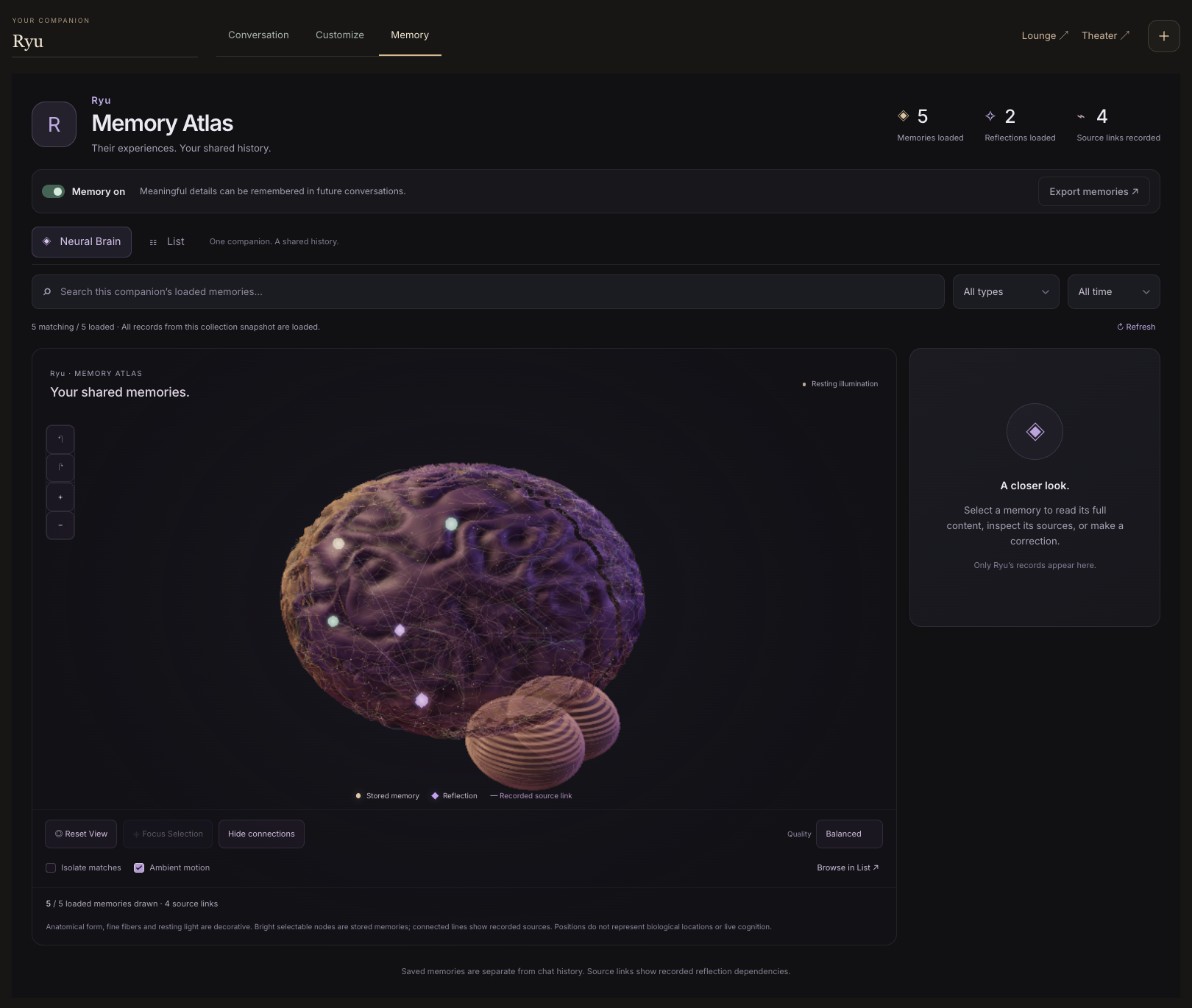
Memory
Without memory: each conversation starts empty.
Fig. 03 — A companion, assembled
A companion starts as a description in its creator's own words: who it is, how it speaks, what it cares about, where its limits are.
A character that lasts.
A companion is an AI character with a lasting identity. It has a written personality, optional long-term memory, a voice, and a place to appear: a chat, a call, a 3D room, a game world. The same companion is the same character wherever its user meets it.
What a chat window lacks.
An ordinary chatbot forgets everything when the conversation ends, sounds like every other chatbot, and gives its user no view of what it keeps about them. A companion that people return to needs three things a chat window does not have: a character that holds, a memory that is honest about what it stores, and controls in the user's hands.
From a written character to a body in a world.
- Creation in six steps
Live - Behind sign-in on the CreatorsHub demo. Identity, appearance, personality and backstory, voice, memory preference, complete. A new companion can be created at any moment by writing who it is, and it answers in that character from its first message. Up to 20 companions per account.
- Personality
Live - Nine fields, among them conversation style, interests, how they speak, boundaries and backstory. Every save is a numbered revision, and a change reaches the companion on the next message.
- Personality studio
Built and tested - Every edit is a numbered version that can be compared word by word, restored, exported and imported.
- A model per character
Built and tested - One gateway puts four families of AI model service behind one interface, and changing a character's model leaves its personality untouched.
- Long-term memory
Live - Memory is off until the user turns it on. A conversation is not copied into memory. Only the user's own statements worth keeping are kept, word for word, and small talk is let go. Over time the system reflects, and each insight stays linked to the memories it came from.
- Careful with change
Built and tested - A repeat strengthens an existing memory; a paraphrase or a contradiction is held for review and never silently overwrites it. A test set of 18 cases ran on the live host with invented data with no failures.
- The user's controls
Live - Everything a companion remembers is open to its user as a searchable list or a 3D atlas, and memory can be switched off at any time (Live). Each memory can be rated, corrected, forgotten or exported (Built and tested).
- Voice
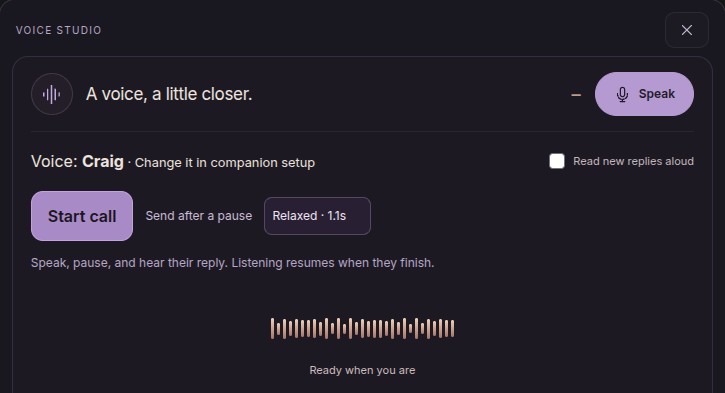
Live - Companions speak their replies, and a voice can be designed from a description. Speech to text and hands-free calls (In testing).
- Memory for other applications
Built and tested - The same memory as a service with its own API and operator console. Every request is signed, and each user-and-companion pair has its own separate store.
- A room in the browser
Live - Behind sign-in. An original three.js penthouse with six camera views and five lighting moods where the companion sits with its user. The avatar's mouth is driven live by its own voice.
- A body in Unreal Engine
Working prototype - A private pilot on our own network. Our own Unreal Engine 5 plugins give a web companion a body in a real-time 3D city. She appears only after her identity is confirmed, walks up to the player, follows, and faces the player when she speaks. She is the same companion as on the web: same personality, memory and voice. Her voice is generated on our GPU server, sent into Unreal as sound over the game stream and played inside the world, and her mouth moves with it. The link runs both ways: Unreal reports about twenty times a second what she is doing, so an interruption stops her at once. The city is rendered on our own workstation and streamed into an ordinary browser page behind sign-in.
- A resident you can talk to
Working prototype - A second AI character lives in the same city. You speak to him by microphone inside the game; he answers aloud, follows on foot and rides in the car.
Your character, your rules.
The character and its limits. What its memory may keep, and who can see and change it. The voice. The AI model behind it. Where it appears: your website, an iPhone app, a 3D room, an Unreal Engine world.
In your product, or as services.
Inside a product we build for you. Or as services your own product calls: companion, personality, memory and voice, each with an API. Or as a chat or voice component dropped into an existing page.
See one assembled.
The figure above. The CreatorsHub demo; companions are behind sign-in.
Working prototype Ryu is the body a web companion is given in Unreal Engine. The three pictures are renders by the character's artist.



Have a companion in mind?
What we do not claim.
A companion does not remember everything, and nothing is promised to be kept for ever. Forgetting removes a memory from use; the product itself says some records and backups may remain for a time. The Unreal world is a private pilot for one viewer on our own network, not a public feature. Lip movement follows loudness and tone, it is not word-accurate lip sync.