
Capability / Simulation & worlds · flight dynamics, Unreal Engine
Mach 3,on the record.
We built a flight simulator in Unreal Engine in which every force on the aircraft comes from a flight-dynamics model, and every number in that model can be traced to a published source.
Fig. 06 — Flight model on the record
The declassified SR-71 flight manual, NASA technical papers, an FAA type certificate data sheet. Every value in a flight model is labelled published, derived, measured or gap.
A simulator that answers to the record.
A flight simulator built on Unreal Engine 5, the JSBSim flight-dynamics library and Cesium's real-world terrain. Aircraft are packages in a folder: a flight model, systems, a cockpit and sounds. A new aircraft is loaded without changing the engine code.
Looks right is not flies right.
A simulator that looks right and flies wrong teaches the wrong thing. Most game-engine "flight" is an animation with a physics nudge. Here the flight model is separate, built from published numbers, and checked against them, so what you see on the dials is what the model computed.
Three aircraft, one framework.
- The framework
Working prototype - Three aircraft packages on one framework: the DC-9-30, the SR-71A, and a 737 from the JSBSim library used to prove a third aircraft loads with no engine code changes.
- DC-9-30
- No ready flight model existed, so we built one from published data: the FAA type certificate data sheet, accident investigation reports and a NASA report, with every estimate marked. Electrical, hydraulic, fuel, pressurisation, flight controls, autopilot, lights and auxiliary power; failures; a cold start. 115 cockpit controls, all bound. Its evidence table has 62 rows: 7 pass against a published figure, 28 calibrated or met expectation, 24 informational and 3 recorded deviations. It flies from Charlotte.
- SR-71A
- A flight model generated from the declassified flight manual and NASA technical papers. Inlet unstart with its roll and yaw, and the restart. Sixteen live cockpit dials, a moving map, a ground-mapping radar view, a night sky, and 33 synthesised sound voices. Status: in progress.
- Flight recorder
- A flight recorder that writes every flight, five samples a second: about 1,700 recorded flights so far.
- Commits
- 66 commits between 8 and 12 November 2026.
Your aircraft, your procedures.
The aircraft or vehicle (a new package: its data, systems, cockpit). The systems and failures to train on. The places to fly. The instruments and recording.
A desktop simulator, shown here.
As a desktop simulator for your hardware. The simulator itself stays separate from this website: it is shown here, not run here.
The model against the record.
Four pictures captured from the running simulator in November 2026.
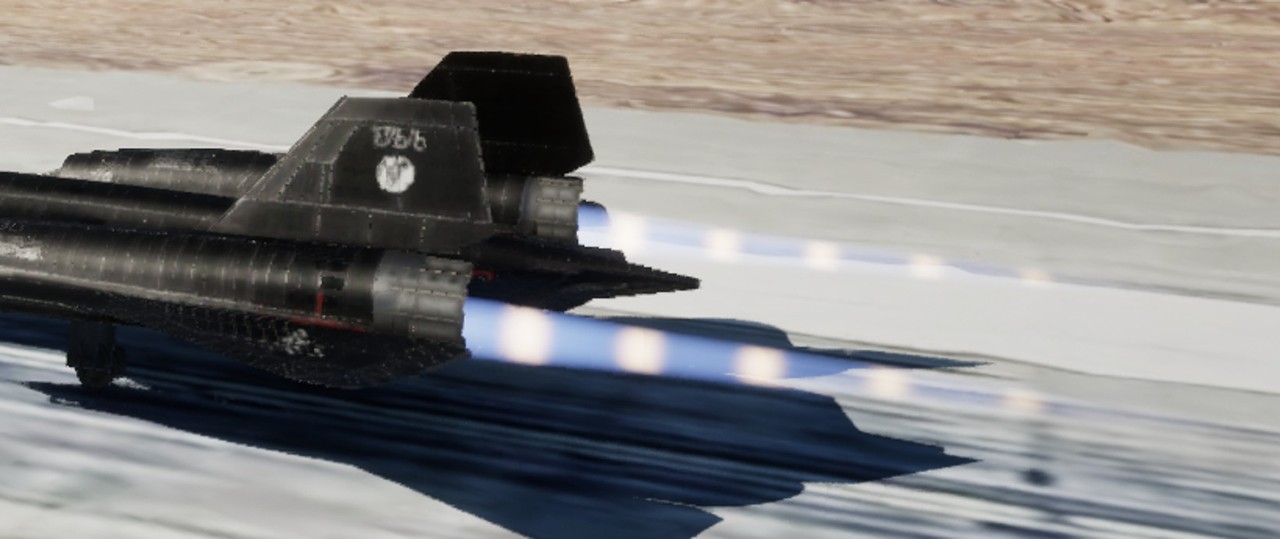
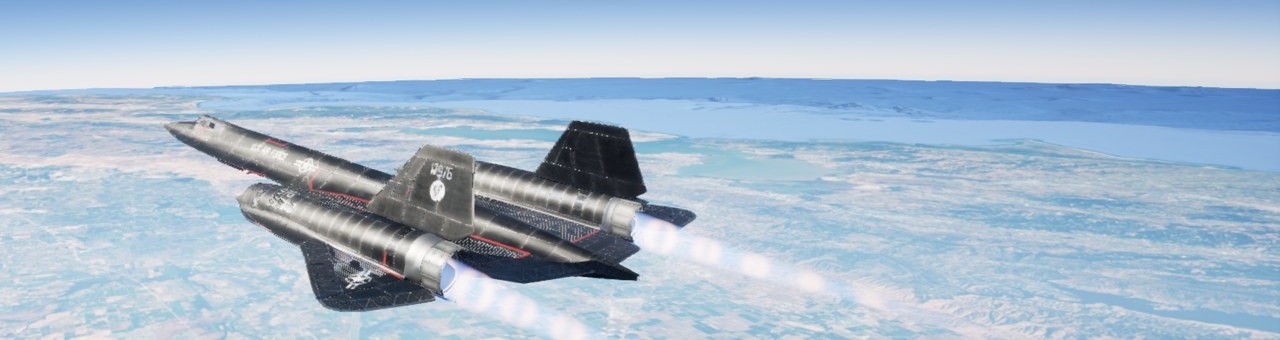
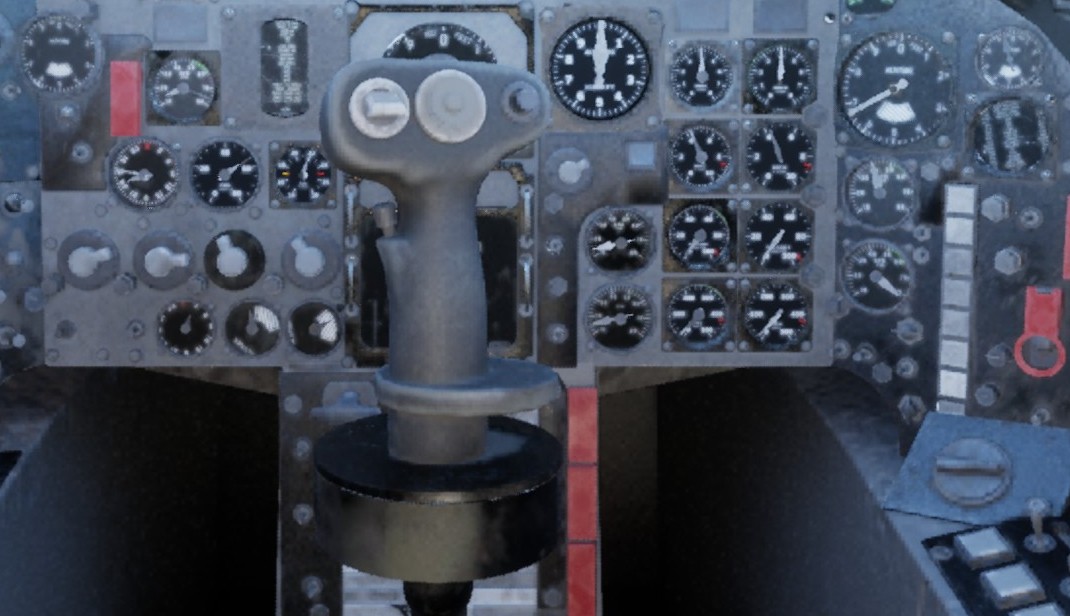
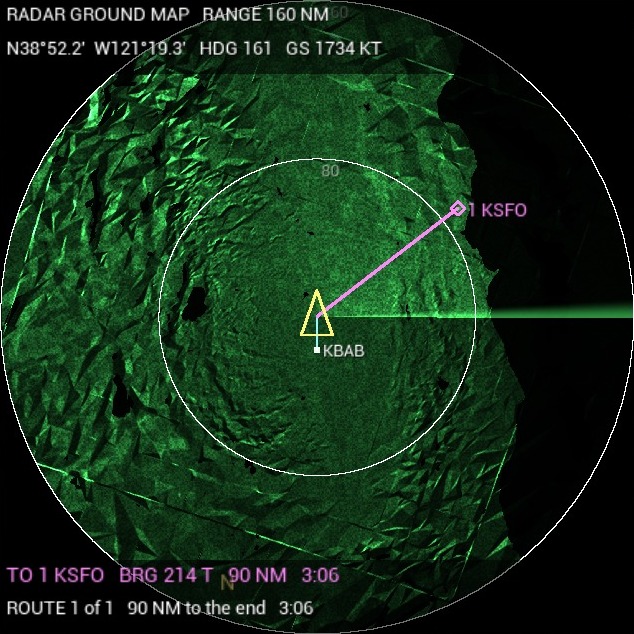
The aircraft and cockpit are third-party 3D models. The flight model, the systems, the behaviour of the dials, the afterburner flames, the displays and the sound are ours. Terrain: Google Photorealistic 3D Tiles through Cesium.
| Speed | Published | Model |
|---|---|---|
| At rest | 25,470 lb | 25,463 lb |
| 100 kt | 27,500 lb | 27,494 lb |
| 200 kt | 29,750 lb | 29,742 lb |
| Mach | 0.95 | 0.98 | 1.00 | 1.05 | 1.10 | 1.15 | 1.20 |
|---|---|---|---|---|---|---|---|
| Published | 14.0 | 13.5 | 7.5 | 6.5 | 7.0 | 7.8 | 8.8 |
| Model | 14.4 | 13.7 | 8.2 | 7.1 | 7.8 | 8.8 | 10.1 |
| Mach | 1.4 | 1.8 | 2.2 | 2.6 |
|---|---|---|---|---|
| Published | 4.0 | 5.6 | 8.0 | 10.5 |
| Model | 4.1 | 5.8 | 8.1 | 10.5 |
| Ceiling | Weight | Left over |
|---|---|---|
| 78,500 ft | 114,700 lb | 347 lb of 18,291 |
| 80,500 ft | 103,600 lb | 466 lb of 16,655 |
| 82,500 ft | 93,400 lb | 593 lb of 15,169 |
| 85,500 ft | 80,300 lb | 676 lb of 13,193 |
Where the model differs from the record we show the difference: around Mach 1 it is on the strong side, and beyond Mach 2.6 it reaches Mach 3.0 sooner and lower than the published climb.
AI characters in a real-time city.
The second kind of world we build is one you share with an AI character. Everything below is a private pilot on our own network unless its label says otherwise.
- An Unreal Engine 5 city
Working prototype - A real-time city with traffic and crowds, built on Epic's City Sample, plus an evening square, rendered on our own workstation.
- A companion with a body
Working prototype - Our own Unreal Engine plugins give a companion made on the web a body in that city. She appears only after her identity is confirmed, walks up to the player, follows, and faces the player when she speaks. Same personality, memory and voice as on the web. How companions work
- Her voice inside the world
Working prototype - Speech generated on our GPU server is sent into Unreal as sound over the game stream and played inside the world; her mouth moves with it. Unreal reports about twenty times a second what she is doing, so an interruption stops her at once.
- Streamed to a browser
Working prototype - The city is streamed into an ordinary web page behind sign-in, with keyboard and mouse driving the player. One viewer, on our own network.
- A resident you can talk to
Working prototype - A second AI character lives in the city. You speak to him by microphone inside the game; he answers aloud, follows on foot and rides in the car.
- The world reports back
Built and tested - Twice a second Unreal tells the companion's service where she is, how fast she is moving and who is near, as observations.
- Characters that act on the world
Built and tested - Not yet demonstrated. The character's AI can ask the world to do things through three tools, each confirmed by a receipt from Unreal.
- A room in the browser
Live - Behind sign-in on the CreatorsHub demo. An original three.js penthouse with six camera views and five lighting moods.
Ryu, the body a companion is given in this city, is pictured on the companions page. None of this is a public or multi-user service yet, and none of it is reachable from outside our own network.
Have a simulation in mind?
What it is not.
It is a working prototype, not a certified training device. It has no shared cockpit, no remote streaming and no hardware controls yet. Not modelled yet on the SR-71: inlet spike and door positions, skin temperature, fuel sequencing.